
A domain (domain name) is the name of a website on the Internet and its address. To understand this, let's draw an analogy: you've been invited to a restaurant. To get there, you need to know its name and address. The same applies to websites on the Internet: to visit a specific website, you need to know its address on the Internet. For example, to visit our website, you need to type https://hostings.info in your browser's address bar.
Why domain names are needed:
Every website on the Internet has its own IP address, besides the domain. This is what the browser relies on when searching for websites. An IP address consists of:
- Four parts separated by dots, for example, 127.101.102.103, in the case of an IPv4 address;
Eight alphanumeric groups, each containing four hexadecimal numbers separated by colons, for example, - 3005:0db6:82a5:0000:0000:7a1e:1460:5334, if you have an IPv6 address.
A domain name is needed so that you don't have to memorize the numerical combinations of the IP address.
Let's draw an analogy: in your phone's contact list, you have people's names and their phone numbers. If you only had the phone numbers, it would be much harder to remember who each number belongs to. It is easier to identify a person by their name rather than by their phone number. The same goes for websites: it's easier to remember a domain than an IP address.
Domain Name System (DNS):
DNS stands for Domain Name System. It is a technology that converts domain names into IP addresses. In other words, DNS acts as a translator from human-understandable language (website names) to computer-understandable (IP address numbers).
What a domain consists of:
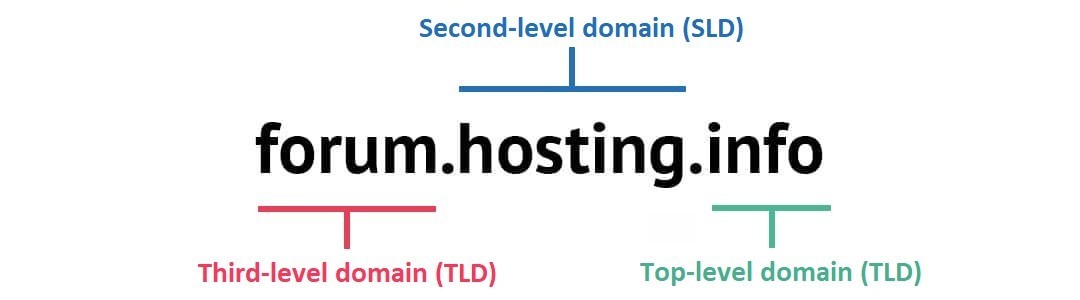
All domains consist of several parts, and these parts are arranged in a strict hierarchy. A domain name consists of:
- A top-level domain (TLD);
- A first-level domain or domain zone;
- A second-level (third-level) domain;
- A subdomain (optional).
A second, third, fourth, or higher-level domain is part of the domain name to the left of the dot. This is the website name created by the owner. For example, the domain, facebook.com - "facebook" is the second-level domain.
A subdomain is a domain name used within the main domain. For example, if you registered the site bestsite.com, you can create subdomains like sub.bestsite.com, sub1.bestsite.com, sub2.bestsite.com. A subdomain is always located to the left of the second-level (and so on) domain and is also separated by a dot.
A first-level domain or domain zone is the first part of the domain after the dot. In the domain facebook.com - ".com" is the first-level domain or domain zone.
A top-level domain, also known as a root domain or simply root, is the dot that comes after the domain extension, but it is not displayed in the browser's address bar and is invisible to the user. For example, in the domain facebook.com, the top-level domain is the dot after .com.
Not a purchase, but a rental
Domain registration is commonly referred to as a purchase, but that is a misnomer. You are not actually buying the domain; you are renting it for a minimum term of 1 year. After a year, you can extend the domain name rental, and so on indefinitely, as long as the domain remains relevant to you. However, once you stop paying for the domain rental, it becomes available for purchase (rental) by other users. Each domain extension may have its own rental term peculiarities. In some extensions, you can rent a domain for up to 10 years at once, while in others, the maximum is one year with annual renewals.
Renewing the rental
If you do not renew the domain rental, your website will stop working. Therefore, it is recommended to renew the domain rental 30-60 days before the rental term expires. Carefully study the domain usage rules with your registrar and try to renew in time.
If you miss the payment and the rental term expires, you usually have an additional 30 days (preferential renewal period) during which you can renew the service. During this time, your website and email on the domain will not work. Your domain will be listed among the available domains, and potential buyers can start bidding on it at domain auctions. After 30 days, if you do not renew the rental, your domain can be purchased by anyone interested.
When a domain becomes available
International domains become available 1-5 days after the preferential renewal period ends.
Of course, you can try to rent the same domain again, but as a former domain owner, you will no longer have any advantages over other users. The domain will go to the first person who pays for the rental.
How a domain differs from hosting
As mentioned earlier, a domain is the name of your website on the Internet. Hosting, on the other hand, is the place where your website is stored. To make your website accessible to users online, it needs to be stored on a special server. The provision of space for storing a website on such a server is called hosting. To have a functioning website, you need to purchase both a domain and hosting.
How a domain differs from a website
A website is one or more interconnected web pages, while a domain is the name of the website. A website's domain can be changed over time if it becomes outdated. This is called rebranding. The website's content remains the same.
Common mistakes when choosing a web hosting
- Do not use a random alphanumeric combination in the domain name. Such domains will never be remembered by anyone.
- A bad strategy is to try to register a domain based on a popular portal, changing a symbol in its name, for example, instead of facebook.com, write ficebook.com. This will not inspire trust in your website; users will simply consider you as fraudsters.
- Do not use overly long and hard-to-read names, such as bestpizzaincitywhereitcanbe.com. Such a domain will have traffic problems, and you will lose part of your audience because users will make mistakes when entering the website name in the browser's search bar.
- Do not use multiple hyphens in names, for example, best-pizza-in-city-where-it-can-be.com. There is nothing wrong with using a single hyphen if it serves to improve the domain's readability. However, if there are more hyphens in the domain name, it implies that the domain consists of several words. It is more challenging to remember a website name with multiple words.