Hosting companies that accept Bitcoin and other cryptocurrencies
Cryptocurrencies have become quite popular recently. There are lots of different cryptocurrencies and Bitcoin (BTC) is the most commonly used. Bitcoin payment is a perfect solution for those users who seek privacy and anonymity on the web. This rating contains hosting companies that accept cryptocurrency payments.


1
We recommend

Hostinger runs promos oftentimes, so you can get a nice package at a very discounted price. Also, these guys treat hosting securit...

2
We recommend
hosting.com offers a variety of packages, including Windows Shared, Reseller and VPS servers. This is not a common feature between...

3

UltaHost is a popular US-based web hosting provider that offers many different hosting plans such as VDS hosting, dedicated hostin...

4
We recommend
AccuWebHosting was founded in New Jersey in 2003. It provides reliable hosting. Has more than 101 025 customers around the world. ...

5
Very nice and user-friendly interface. Each plan has a full and detailed description of tech specs and features. The prices are qu...

6
Interserver is a hosting provider with a wide range of services, including email hosting with a separate gateway server, more than...

7

On the market
18 yearsFounded in 2008
8
ishosting is an Estonian provider offering VPS, dedicated servers, storage, and VPN services with global infrastructure across Tie...

9
Fornex is a European (Ukraine, Russia, the Netherlands, and Germany) hosting company that has been providing hosting and infrastru...

10
Although the company offers only Shared and Hybrid server hosting, the package configurations seem to be thought-out and suitable ...

11
KoDDoS is a premium hosting service that specializes in high-end hosting and unrivaled mitigation of Distributed Denial-of-Service...

12
Hawk Host was founded in 2004 and provides shared hosting, reseller hosting, semi-dedicated and virtual hosting in Dallas, Los Ang...
FAQ
?
💲 Can I receive refunds when I pay with cryptocurrency?This depends on the policies of the individual web hosting provider. Cryptocurrency transactions are typically irreversible, but some providers may choose to refund you in cryptocurrency or another payment method at their discretion. Always check the provider's refund policy before making a payment.
?
?
📱 What are the potential risks of using cryptocurrency for web hosting services?Cryptocurrency values can be volatile, meaning the price of your hosting could change dramatically in a short time. Additionally, cryptocurrency transactions are generally irreversible, so if you make a mistake in your payment, it may be difficult or impossible to rectify. Finally, not all hosting services offer support for cryptocurrency, limiting your choices.
Market analysis (Price)
| Minimum | Average value | Maximum | |
|---|---|---|---|
| Hosting | undefined NaN /year | undefined NaN /year | undefined NaN /year |
| VPS/VDS | undefined NaN /year | undefined NaN /year | undefined NaN /year |
| Server | undefined NaN /year | undefined NaN /year | undefined NaN /year |
Market analysis (Disk Space)
| Minimum | Average value | Maximum | |
|---|---|---|---|
| Hosting | 0.30 Gb | 77.19 Gb | 350.00 Gb |
| VPS/VDS | 10.00 Gb | 114.17 Gb | 400.00 Gb |
| Server | 50.00 Gb | 2055.80 Gb | 8000.00 Gb |
Market analysis (CPU Cores)
| Minimum | Average value | Maximum | |
|---|---|---|---|
| VPS/VDS | 1.00 pcs | 2.42 pcs | 6.00 pcs |
| Server | 2.00 pcs | 8.41 pcs | 24.00 pcs |
Market analysis (Memory (RAM))
| Minimum | Average value | Maximum | |
|---|---|---|---|
| VPS/VDS | 1.00 Gb | 5.67 Gb | 16.00 Gb |
| Server | 4.00 Gb | 70.67 Gb | 256.00 Gb |
The Cryptocurrency Landscape 2026 in the Hosting Industry
The initial enthusiasm surrounding cryptocurrencies as a payment option was also met with a lot of scepticism and for good reason as it was both unknown and highly volatile, and most people thought of it as a “fly by night” craze. Well, this form of payment has actually evolved into a mature and trusted form of payment, with value in many cases increasing as time goes by. In the hosting industry, the question is no longer if providers accept Bitcoin, but rather if they accept than any other crypto. The reason providers need to offer other options than just plain Bitcoin is more about operational efficiency, stablecoin dominance, regional payment accessibility, and the infrastructural convergence of on-chain assets with off-chain services. In this review I will try to give you more insight into the cryptocurrency hosting market, list my top 3 providers and their options for digital assets used for payment.
Why Crypto Payments in Web Hosting is Relevant More Than Ever
The practical use of crypto payments in the web hosting industry today is mostly driven by two factors – users looking for privacy and users avoiding regulatory restrictions. It is almost common practice now for “anonymous hosting providers” to include a variety of cryptocurrencies, such as Monero, as a payment method, a payment that completely separate from their personal identity, thus enabling users to deploy VPS instances within minutes using only a public key. This operational model directly supports 'bulletproof' hosting companies, which, despite mounting pressure, still continue to operate by making use of crypto's pseudonymity to shield their payment rails from seizure. At the same time, major financial watchdogs have stepped up their scrutiny, with OFAC and Europol strongly targeting crypto wallets linked to known bulletproof infrastructure providers in 2024, forcing legitimate offshore hosts to adopt complex mixing services just to remain compliant with KYC/AML handoffs. The result is a tense system where crypto isn't just a form of payment, but also the operational layer that allows high-risk, and sometimes shady content platforms and privacy-conscious journalists to exist on the same server space, all while other payment systems such as Stripe and PayPal for example, strongly prohibit these type of transactions, leaving cryptocurrency as the only option for many.
Another point is that people are looking for instant settlement, lower fees, and censorship-resistant infrastructure, and a lot of businesses are starting to avoid old-school payment methods like credit cards, rather opting for wallet-to-wallet transactions that saves them a buck or two by cutting out the “middleman fees”.
For web hosting providers, the appeal of crypto is also operational. Cryptocurrency payments can’t be reversed, and this lowers the risk of chargebacks and fraudulent disputes that is common with traditional payment methods.
Which Cryptocurrencies Are Actually Being Used?
There are so many cryptocurrencies around it is mind boggling! I remember a time where there were new “coins” popping up daily just as this craze began, everyone was looking to cash in. The landscape of accepted cryptocurrencies is complex to say the least and often a bit misrepresented. While the belief is that hosting providers accept a "wide range" of crypto, there are actually only a few that stand out.
Stablecoins: The Functional Workhorse of the Crypto World
When most people think of cryptocurrencies, Bitcoin and Ethereum will probably come to mind first, but these types of crypto are highly volatile. Stablecoins on the other hand, with the USD Coin (USDC) and Tether (USDT) being the most popular by far, has their value pegged to currency like the US dollar for example, so their value remains more or less predictable, and then it protects hosting providers from the crypto price swings that can make recurring billing a nightmare. Another reason is that Stablecoin transactions also settle in minutes on blockchains that operate 24/7, bypassing the banking delays and foreign exchange costs that eat into international payments. As mentioned before, USDT and USDC dominate this space, making up for probably 90% of stablecoin payments.
I read an article a while back about a hosting provider that started offering crypto as a payment method, and after this integration 24% of their total customer paid cryptocurrency, this just shows how this form of payment is here to stay!
TRON (TRX) has also become a significant player on tythe crypto scene over the past few years, but mostly as an infrastructure layer rather. What makes this crypto currency great is its speed and really low transaction fees. To give you an example their transfer fee is about $0.09 compared to Ethereum's $3.73. This makes it an efficient and cost-effective rail for settling stablecoin transactions, particularly across emerging markets in Asia and other regions with limited banking infrastructure.
Beyond Stablecoins: The Role of Traditional Assets
While stablecoins absolutely dominate transactional volumes these days, the other, more well-known, crypto cryptocurrencies such as Bitcoin (BTC), Ethereum (ETH), Litecoin (LTC), and Solana (SOL) are still very popular options, mostly for those that have little knowledge about crypto as one tends to go after names you recognise, and for users who prefer to spend their assets directly. Many payment gateways, such as the one integrated into Hostinger (we will get into details on this provider later in this review) via CoinGate, accept over 70 different cryptocurrencies! Yes, you read that right, 70! This offers users the flexibility to pay with whatever assets they are holding. However, these transactions often come with a few trade-offs with things like longer confirmation times (it could be up to 10-30 minutes for Bitcoin) and the potential tax implications of selling a volatile asset for a service, which a lot of countries are starting to implement.
Toncoin and Other "Crypto Junk": A Wake-Up Cal
In my honest opinion, the majority of crypto are junk, and coins that immediately come to mind are the “Useless Ethereum Token (UET)” (even the name says it), SquidGame Token (which was a rug pull), BitConnect (a massive Ponzi scheme), as well as Toncoin (which are now rebranded to Gram). Hosting providers tend to avoid these "crypto junk" coins because they lack sufficient market depth, meaning even a small payment can drastically shift in value even before it is settled, leaving hosting providers with less than what was invoiced (or more in some cases, but this is rare). Many of these coins operate on obscure blockchains with unreliable finality, where payments can be reversed or never become spendable and as the assets themselves cannot be liquidated on trusted exchanges, it creates accounting issues instead of making money.
My List of the Top 3 Hosting Providers That Has a Focus on Crypto Payments
As promised in the beginning of this review, I have listed the top 3 hosting providers that all have solid cryptocurrency integrations. They are Hostinger, Hosting.com, and UltaHost.
1. Hostinger
The Leader for Direct Crypto Payments

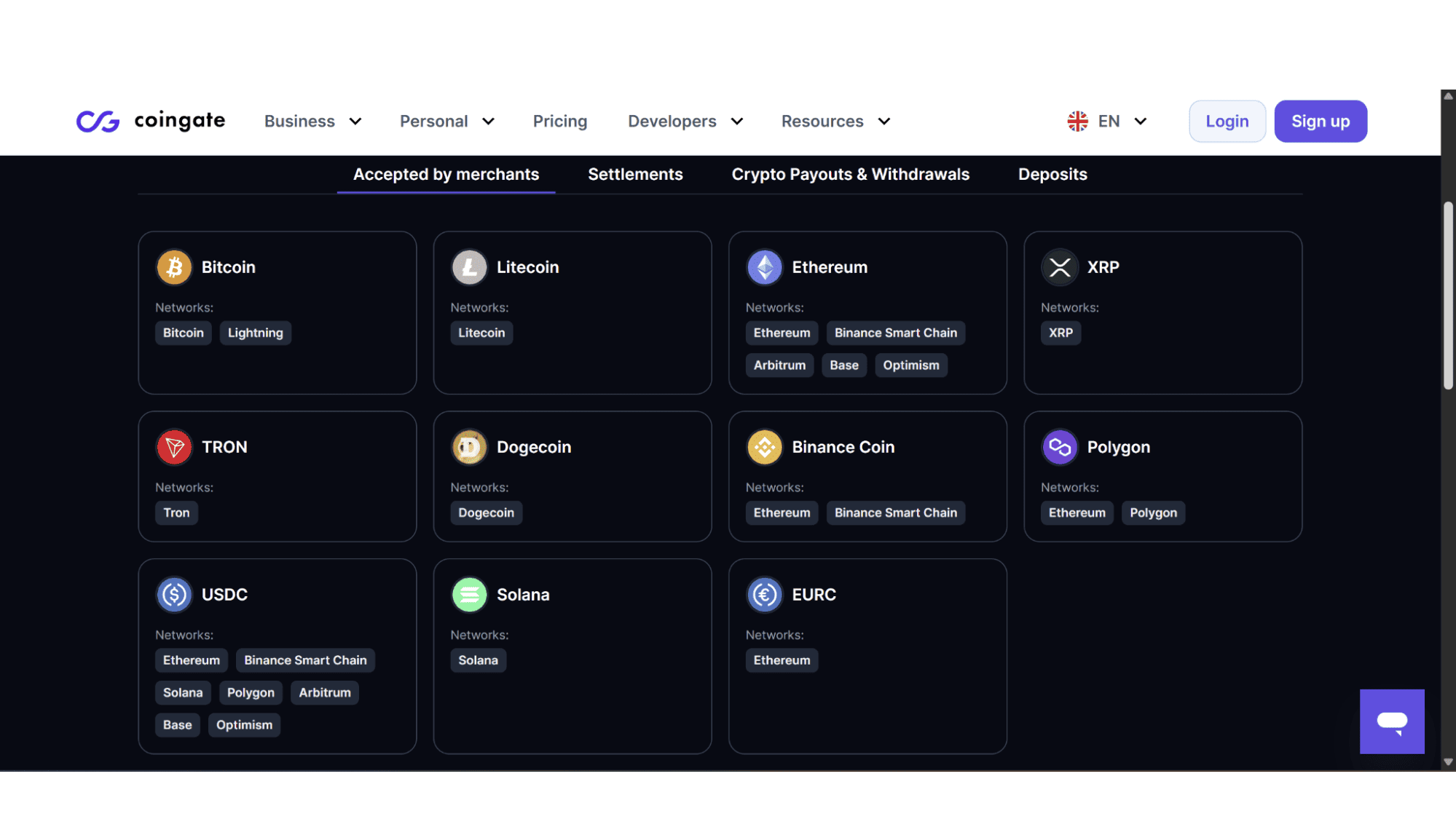
Hostinger is one of the biggest names in the hosting industry and one of the few well-known brands that have implemented a solid, direct cryptocurrency payment integration through CoinGat, one of the most famous and trusted web-based cryptocurrency payment gateways and processing services. This allows their clients to pay for any of their hosting services with over 70 different digital assets, that includes Bitcoin, Litecoin, Ethereum, XRP, Solana, Tron, Dodgecoin, Binance Coin, Polygon, USDC, and EURC to name just a few.
One thing to note though is that payments from Russia and Belarus are not accepted by Hostinger, not even if you pay by crypto.
Key Cryptocurrency Payment Features:
- Direct Checkout Integration: The process is seamless, just like paying by credit cards. Users simply select cryptocurrency at checkout and are redirected to the CoinGate website to do the wallet-to-wallet payment.
- Huge Range of Crypto: Like I mentioned before, this crypto-payment gateway supports a massive list of cryptocurrencies such as BTC, ETH, LTC, DOGE, SOL, and many other major stablecoins like USDC and USDT.
- No Cost for The User: CoinGate takes the hit with the processing costs, and Hostinger locks in the exchange rate at the moment of payment, so if the coin’s value changes it won’t affect you.
- No Auto Renews: This is an important point to keep in mind as this form of does not support automatic recurring billing, so you need to manually do the transaction again when it comes time to renew your plan, and if you want a refund you are likely to get it in credits and not a crypto refund.
2. hosting.com
A Much More Limited Approach

Hosting.com is a provider I have worked with countless times, I trust them and enjoy hosting my sites with them as they are well-established, reliable, have great customer support, and offer a wide range of hosting services such as shared hosting, VPS hosting, domain registrations, and more, but their acceptance of cryptocurrency is limited compared to Hostinger for example. At the time of writing, they only accept Bitcoin.
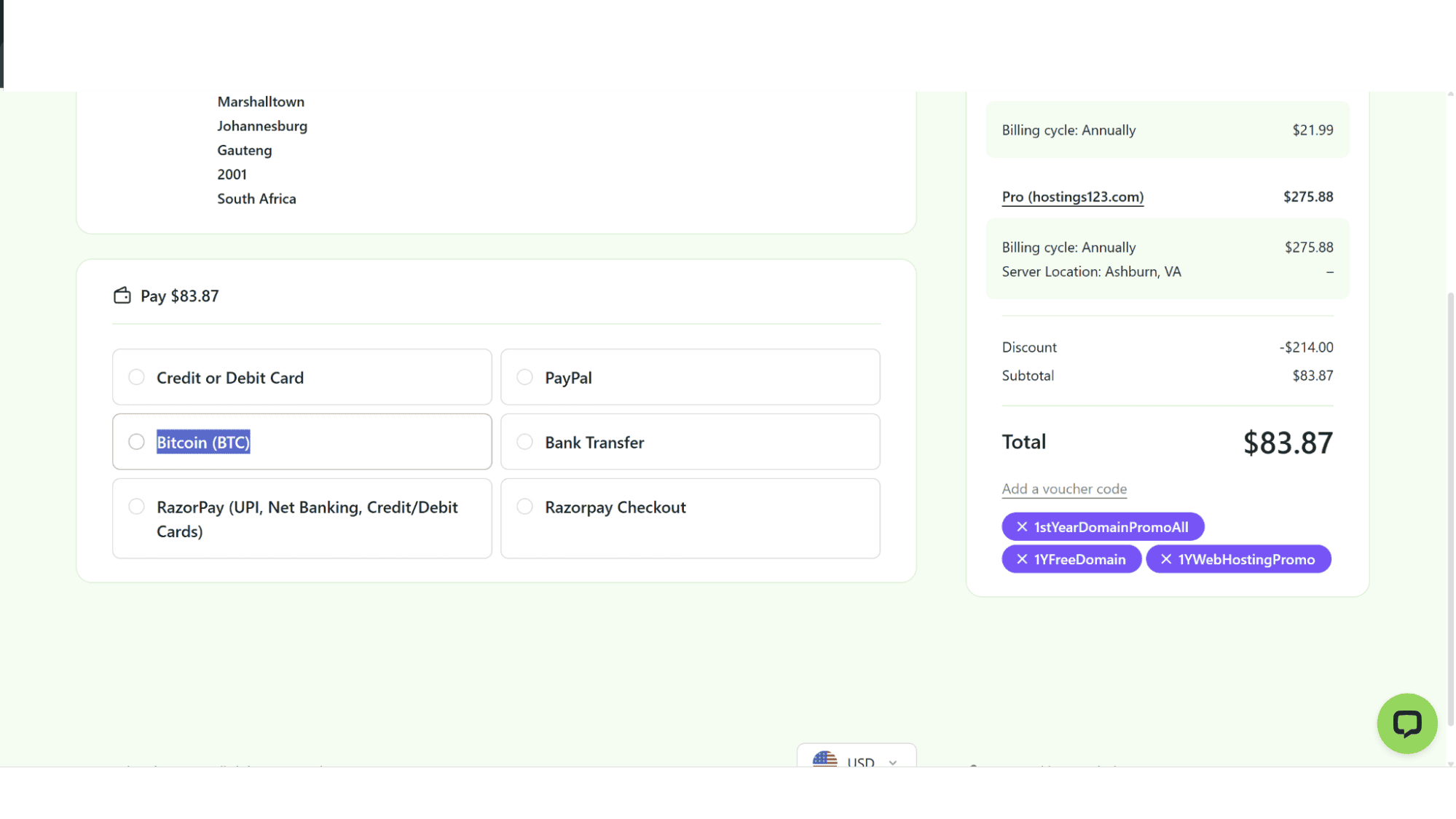
Key Bitcoin Payment Features for:
- Most Famous Crypto: Bitcoin is by far the most famous crypto currencies and also the most valuable one. A lot of people have and are still, investing in Bitcoin, which makes the market so much bigger for hosting providers to accept this form of payment.
- Borderless Transactions: As Bitcoin (BTC) works outside of normal banking systems, it gives providers such as Hosting.com instant access to customers around the world without first having to establish a payment infrastructure within that specific country for that specific currency.
- No Risk of Chargebacks: Accepting payments from credit cards can cause headaches for providers with chargebacks, and it is more frequent than one realizes. Bitcoin transactions on the other hand are not reversible so there’s no issues.
- Great for Users Focused on Privacy: If you pay by Bitcoin you don’t need to share any personal information to anyone and can stay completely anonymous.
3. UltaHost
A Flexible Crypto-Friendly Hosting Company

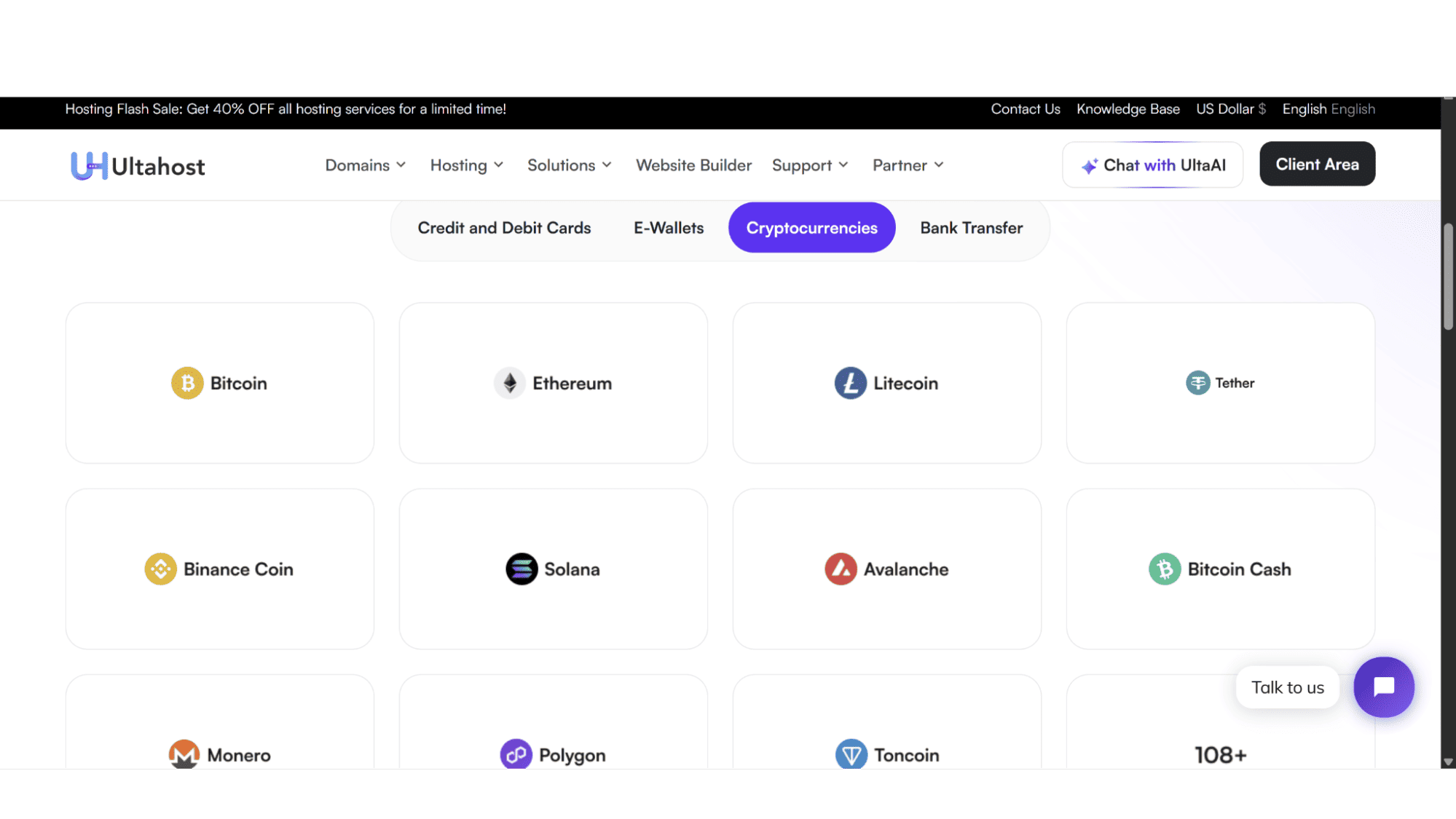
If you thought Hostinger gave you a lot of options when it comes to paying with crypto, UltaHost will blow your mind! This provider is another major player in the hosting industry that is almost overly crypto-friendly. They accept payments by Bitcoin, Ethereum, Litecoin, Tether, Binance coin, Solana, Avalanche, Bitcoin Cash, Monero, Polygon, Toncoin, as well as 108 other crypto currencies.
Key Cryptocurrency Features:
- Huge Variety: UltaHost accepts all the famous crypto coins and assets as well as most of the lesser-known ones too. In total, over 120 different cryptocurrencies which can be used alongside standard options like PayPal and Credit Cards.
- Secure Payment Processing via Cryptomus: UltaHost runs their crypto payments through the Cryptomus gateway, which handles the technical backend and provides a simple checkout experience where customers select cryptocurrency as their payment method. A very secure and trusted gateway.
- Automated Confirmation and Invoice Updates: Once a crypto payment is made, users usually wait for about 30 minutes for the blockchain confirmations, and then UltaHost's system automatically marks the invoice as paid, thus reducing manual workloads and saving time.
Frequently Asked Questions
1. Will I be charged extra fees for paying with cryptocurrency?
It is very unlikely as most providers don't add any processing fees for crypto payments because, but it would be wise to double check with your individual wallet provider as they may charge network fees, also known as “gas fees”.
2. How long does it take for my crypto payment to be show?
It is quick! After you send the crypto from your wallet, the provider's system usually detects it within a few minutes and may mark the invoice as "pending" or "processing". Bitcoin usually takes between 10 minutes to an hour, while some are near instant.
3. What happens if I send the wrong amount or the exchange rate changes?
If you send an amount that doesn't match the invoice exactly, providers typically credit the overpayment to your account balance or require you to settle any amount still outstanding if you paid too little. The exchange rate is usually locked in at the moment you do the payment.
4. Can I use cryptocurrency for automatic recurring billing?
Unfortunately, you can’t. As crypto is volatile and changes a lot, providers don’t allow this.
5. How do refunds work if I paid with cryptocurrency?
Since blockchain transactions can’t be reversed, providers will most likely just add a credit to your account and won’t refund you in crypto.