Flexible VPS Hosting Built for Africa
There’s a point where ordinary web hosting simply isn’t enough.
Maybe you’re running several websites, deploying applications, setting up Docker containers, hosting an n8n instance, or you just want more control over your server. That’s where a VPS starts making sense.
HOSTAFRICA’s Linux VPS offering is particularly interesting for African users because its servers are hosted in African data centres. Rather than hosting an African website or application thousands of kilometres away, you can keep your infrastructure closer to the people actually using it.
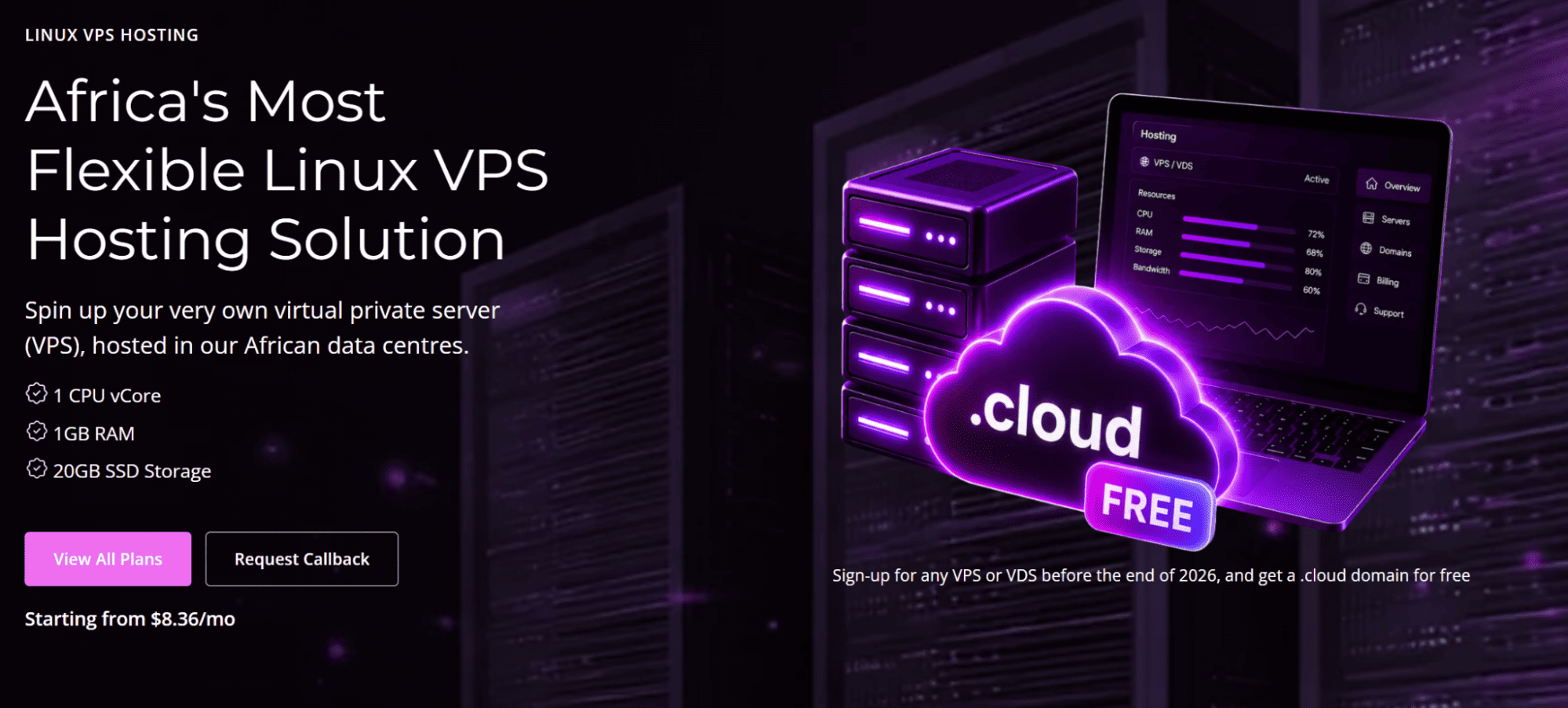
The VPS plans use KVM virtualisation, NVMe SSD storage, include unlimited traffic, and provide full server-level control. There’s also API, CLI, and MCP access, which makes the platform worth looking at for developers who want to automate more of their infrastructure.
But specifications only tell part of the story.
Let’s take a closer look at what HOSTAFRICA actually offers.
HOSTAFRICA VPS Plans: What Do You Get?
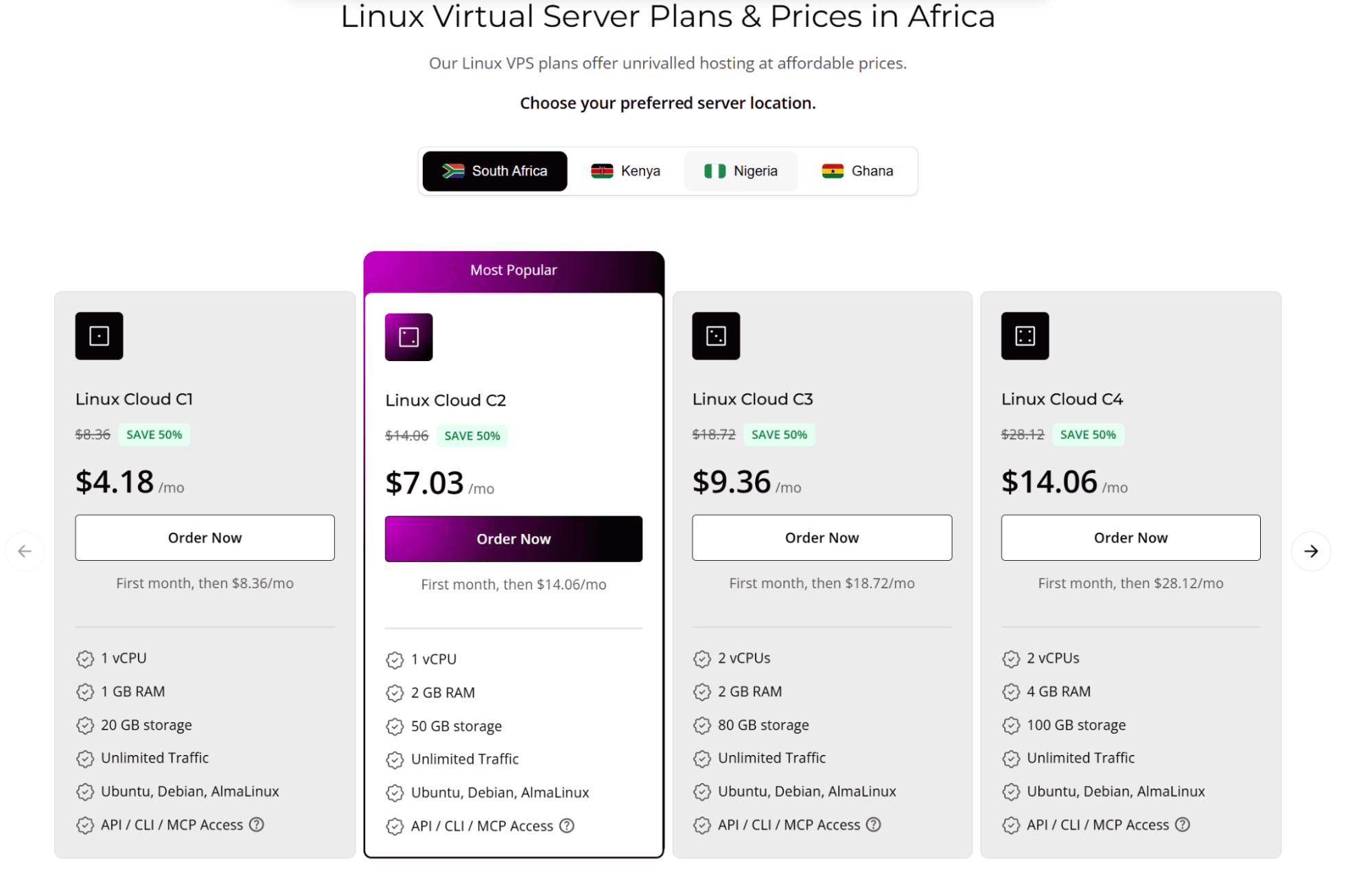
HOSTAFRICA currently offers several Linux Cloud VPS configurations, starting with a relatively small server and scaling upward depending on the resources you need.
All of the plans use KVM virtualisation. In simple terms, this means your VPS behaves much more like an independent server than a traditional shared hosting account.
You get allocated CPU, RAM, and storage resources, while retaining the flexibility that makes virtual servers considerably more affordable than dedicated hardware.
At the entry level, there’s the Linux Cloud C1.The regular price is $8.36 per month. This is the kind of server I’d look at for smaller workloads, testing, learning Linux, lightweight applications, or development environments.
The Linux Cloud C2 moves things up to 1 vCPU, 2 GB RAM, and 50 GB storage, while the C3 offers 2 vCPUs, 2 GB RAM, and 80 GB storage.
For workloads that need more memory, the Linux Cloud C4 provides 2 vCPUs, 4 GB RAM, and 100 GB storage.
The nice thing here is that you don’t necessarily need to start with an oversized server. You can choose something appropriate for the workload you have now and scale as your requirements grow.
Performance: KVM, NVMe, and Intel Hardware
HOSTAFRICA’s VPS infrastructure is built around KVM virtualisation.
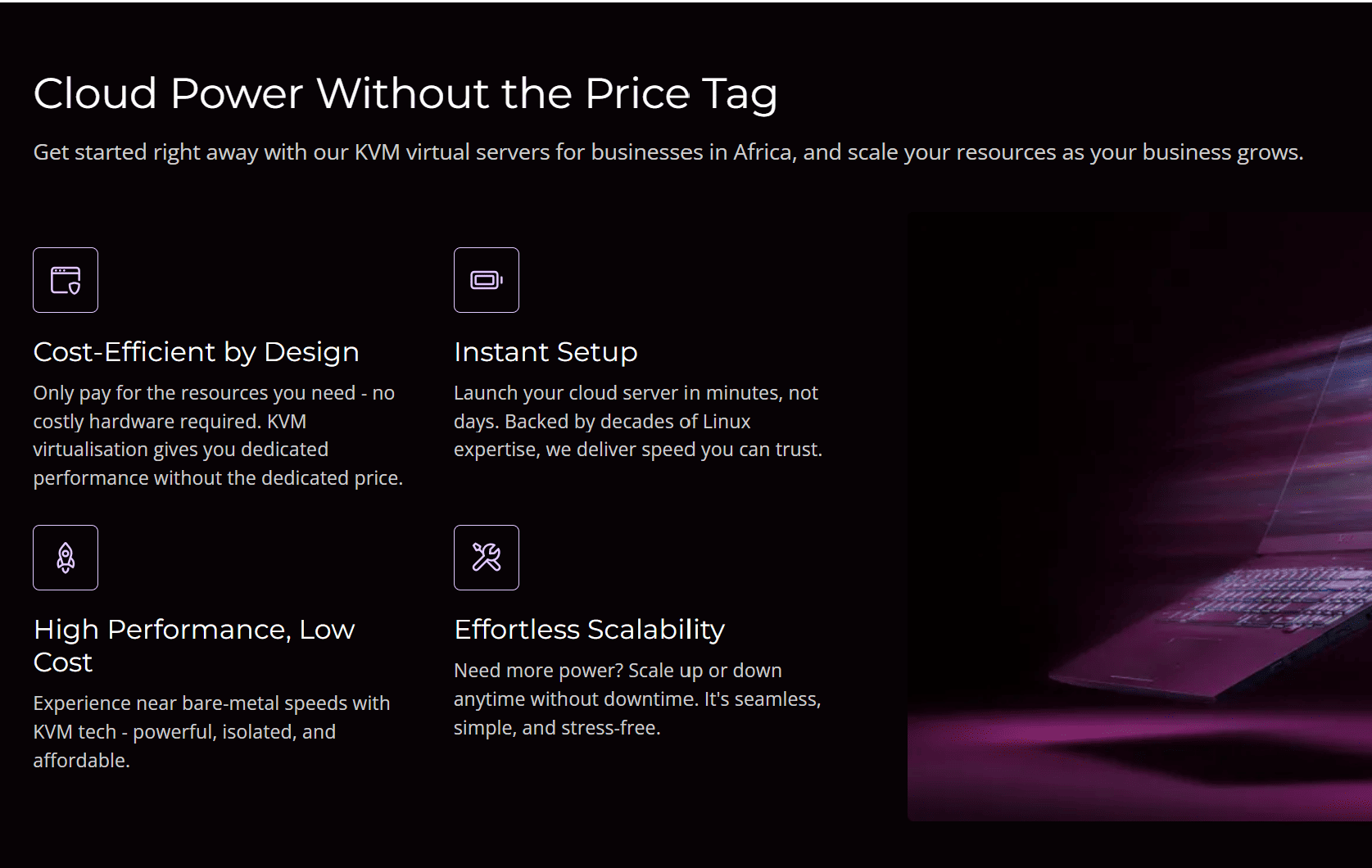
KVM provides a fully isolated virtual machine environment, which gives you OS-level control over your server. If you’ve only ever used shared hosting, it’s a significant step up in flexibility.
You’re free to configure the server around what you’re actually trying to run rather than working within the restrictions of a normal hosting account.
HOSTAFRICA also uses NVMe SSD storage, alongside Intel Xeon Scalable processors. The company lists the Intel Xeon Gold 6330 as an example of the processors used within its infrastructure.
That combination should make the VPS suitable for considerably more than hosting a basic website.
You could use one for web applications, development environments, databases, automation platforms, VPNs, multiple websites, containerised applications, or other workloads where having control of the underlying server matters.
There’s also a 99.9% uptime guarantee.
Hosted in Africa
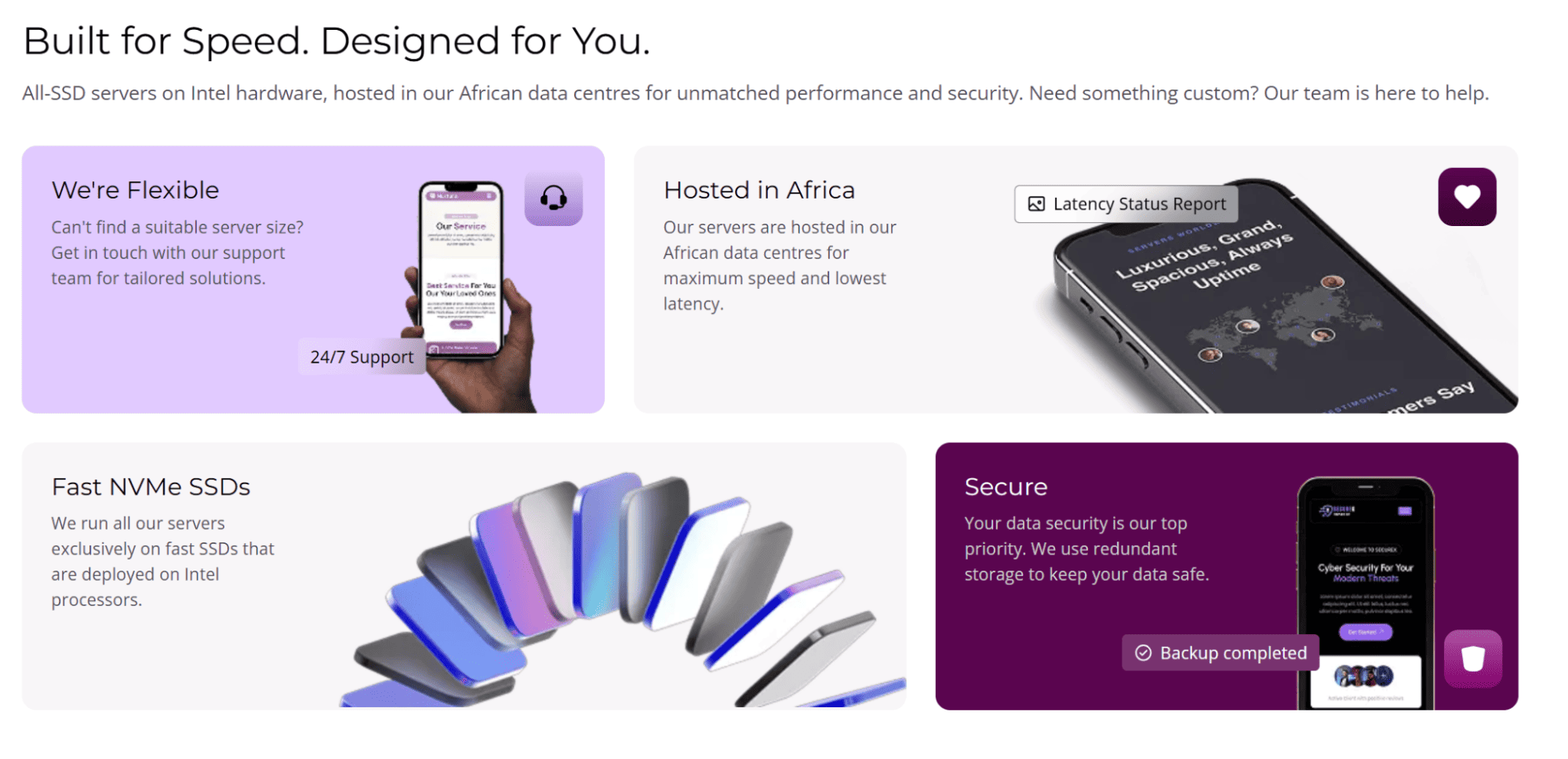
This is probably one of HOSTAFRICA’s most important advantages.
For businesses primarily serving African users, server location is worth paying attention to. Hosting closer to your audience can reduce the physical distance data needs to travel, which can help with latency compared with hosting the same workload much farther away.
It also gives African developers and businesses another option beyond automatically deploying everything to Europe or North America.
That makes HOSTAFRICA particularly interesting if most of your customers, employees, applications, or users are based in Africa.
Full Root and SSH Access
HOSTAFRICA’s Linux VPS servers give you full root and SSH access.
That means you aren’t limited to whatever applications happen to be available inside a traditional hosting control panel.
You can configure the operating system, install packages, deploy your own applications, change server settings, configure security rules, and generally build the environment around your workload.
HOSTAFRICA supports Linux distributions including Ubuntu, Debian, and AlmaLinux, and ISO mounting is also available if you need more flexibility.
Of course, control comes with responsibility.
A VPS is considerably more hands-on than shared hosting. If you’re managing the server yourself, you’ll need to understand things such as updates, SSH access, firewall configuration, backups, and general server security.
For developers and system administrators, that freedom is precisely the attraction.
API, CLI, and MCP Access
This is where HOSTAFRICA’s VPS offering becomes a little more interesting.
Every Linux Cloud plan shown on the site includes API / CLI / MCP access.
API and command-line access are useful if you want to automate infrastructure tasks rather than clicking through a dashboard every time something needs to change.
The MCP access takes that idea further by allowing compatible AI tools to interact with HOSTAFRICA infrastructure.
For example, HOSTAFRICA’s MCP capabilities can be used for VPS management tasks such as starting, stopping, or rebooting servers, working with backups, managing firewall ports, and checking infrastructure information through supported AI workflows.
That won’t matter to everyone.
If you simply need a VPS to host a website, you may never touch it. But for developers experimenting with AI-assisted development, infrastructure automation, and agent-based workflows, it’s a genuinely useful addition.
What Can You Run on a HOSTAFRICA VPS?
This is where having your own virtual server becomes useful.
You aren’t buying a VPS specifically for WordPress, Docker, automation, or a VPN. You’re buying server resources that you can configure for the job you have in mind.
That opens up quite a few possibilities.
You could use your VPS to run WordPress, host applications with Docker, create self-hosted n8n automation workflows, deploy Supabase, or configure WireGuard for a private VPN.
Developers could also use it for APIs, staging environments, databases, development servers, and custom web applications.
Businesses, meanwhile, could run internal applications or infrastructure that needs more flexibility than ordinary web hosting provides.
This versatility is one of the main reasons to choose VPS hosting in the first place.
Scalability
One mistake people make when buying a VPS is paying for far more servers than they actually need.
HOSTAFRICA’s tiered plans make it possible to start relatively small and increase your resources as your workload grows.
A personal project or test environment might be perfectly comfortable on one of the smaller configurations. If it eventually becomes a production application with more users, you can move towards a configuration with additional CPU, RAM, and storage.
That’s a much more sensible approach than paying for unused capacity from day one.
And if the standard configurations don’t suit your requirements, HOSTAFRICA also encourages customers to contact its team about a more tailored solution.
Bandwidth and Network
Another detail worth mentioning is traffic.
HOSTAFRICA lists unlimited traffic across its Linux Cloud plans, with its technical specifications referencing bandwidth of up to a 1 Gbps port, subject to its fair usage policy.
That can be useful for workloads where traffic varies from month to month and you don’t want to constantly worry about a relatively small bandwidth allowance.
As always, “unlimited” doesn’t mean literally infinite resources, so anyone expecting unusually high traffic should check the applicable fair usage terms first.
Backups
Additional backup plans are available for HOSTAFRICA VPS customers.
I’d strongly recommend having some form of backup strategy if you’re running anything important on a VPS.
Root access gives you plenty of freedom, but it also means it’s entirely possible to break something yourself. A bad update, configuration mistake, failed deployment, or compromised application can quickly turn into a much bigger problem when there’s no recent backup available.
For production workloads, backups shouldn’t really be treated as optional.
Support
VPS hosting can get technical surprisingly quickly, so access to actual support matters.
HOSTAFRICA provides several ways to get assistance, including support tickets, live chat, and its knowledge base.
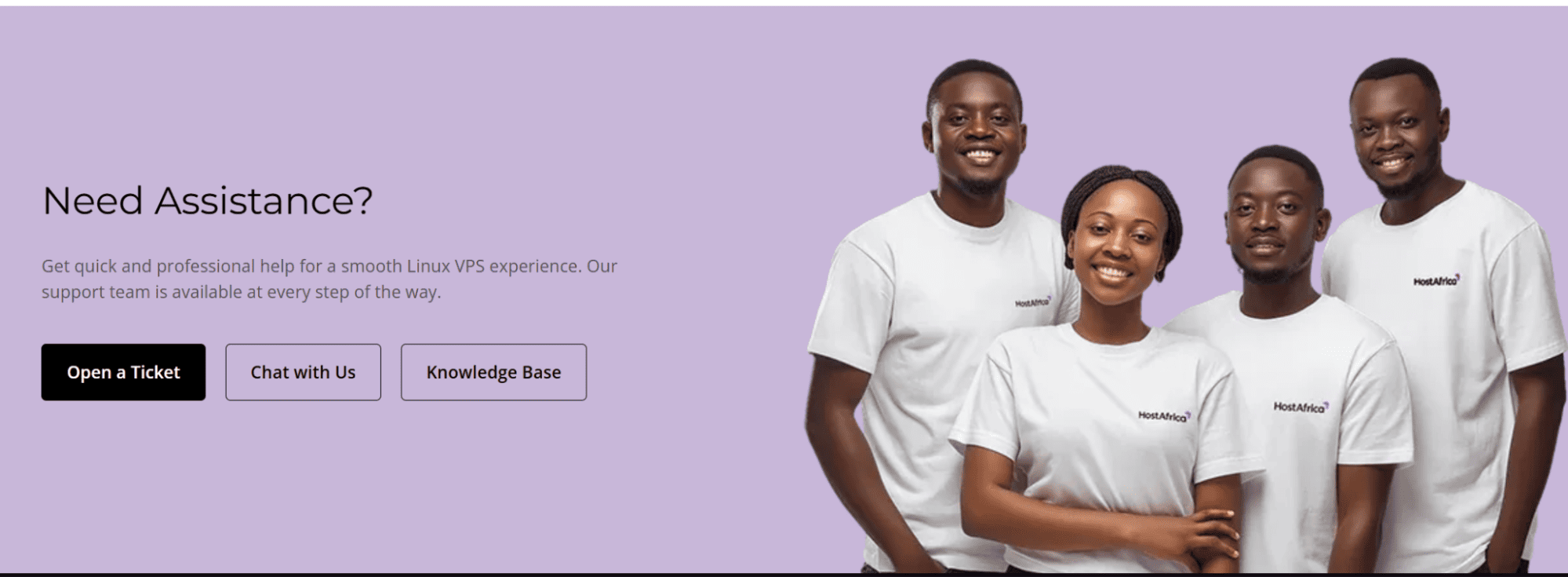
It’s still important to remember that having support available doesn’t make a VPS the same thing as fully managed hosting. If you choose a self-managed environment, you’ll still be responsible for much of what happens inside your server.
Security and Server Control
With a Linux VPS, security is partly about what the provider gives you and partly about what you do with it.
KVM provides isolation at the virtual machine level, while HOSTAFRICA’s infrastructure uses redundant storage to help protect customer data.
But once you have root access, you also have responsibility.
That means keeping your operating system updated, securing SSH, configuring appropriate firewall rules, limiting unnecessary ports, maintaining backups, and keeping the applications running on the VPS patched.
For experienced users, that level of control is a major advantage. Beginners should simply understand that VPS hosting involves more administration than standard web hosting.
Pros and Cons
Pros
- African VPS locations in South Africa, Kenya, Nigeria, and Ghana
- MCP access for AI and automation workflows
- Multiple Linux distributions
- 99.9% uptime guarantee
- Scalable VPS configurations
- Local support options
Cons
- Managing a VPS requires more technical knowledge than shared hosting
- Entry-level configurations may be too small for resource-heavy workloads
- Users who simply want to host a basic website may find normal web hosting easier to manage
Final Thoughts
HOSTAFRICA’s Linux VPS offering makes the most sense when you look at it in an African context.
You’re getting the things you’d expect from a modern VPS, KVM virtualisation, NVMe storage, root access, scalable resources, and a 99.9% uptime guarantee, but with infrastructure available much closer to African users.
The addition of API, CLI, and MCP access means developers aren’t limited to managing infrastructure through a web dashboard. There’s room for scripting, automation, and increasingly AI-assisted infrastructure management.
That’s a much stronger story than simply competing on how many gigabytes of RAM you can get for the lowest monthly price.